Friday, 8 January 2016

NDM: WEEK 15 (i)

Telegraph criticised by watchdog for 'misleading' Michelin advertorial

The Telegraph home page


http://www.theguardian.com/media/2015/dec/30/telegraph-criticised-asa-watchdog-michelin-advertorial

The Telegraph has been reprimanded by the advertising watchdog for failing to adequately label an online advertorial for Michelin tyres. The Advertising Standards Authority said the article and video on Telegraph.co.uk, which compared Michelin tyres with an unnamed budget brand, were misleading and did not make it clear they had been paid for.The Telegraph argued that visual and written cues, such as the words “in association with Michelin” indicated there was a financial arrangement. However, the ASA said the labelling was “insufficient to identify the content specifically as an ad” rather than sponsored editorial, over which the newspaper retained control.

  • Labelling of sponsored and paid-for articles is becoming an increasingly thorny issue for publishers, which have turned to “native” advertising that looks like editorial to compensate for falling revenues from traditional print and display advertising online.
  • Online-only publishers such as BuzzFeed have focused heavily on paid-for articles and many have strict guidelines on how to ensure readers are aware they are seeing an ad.

NDM: WEEK 14 (ii)

Turn off, shut down, log out: the digital detox holiday is here

Couple on a remote beach


http://www.theguardian.com/media/2015/dec/26/digital-detox-holidays-turn-off-shut-down-log-out

Couple on a remote beach
The trend for “digital detox” has been around in the America for some time, but the urge to go “off grid” is taking hold here too, along with a mini-boom in specialist companies looking to cash in. This month, pop star Ed Sheeran announced he was stepping off the social media bandwagon – no mobile phones, emails or Twitter for a whole year. “I find myself seeing the world through a screen and not my eyes,” he wrote (on his Instagram account, of course).

  • Tanya Goodin, the founder of Time To Log Off, knows how he feels. Her eureka moment came when she realised she hadn’t read a book in four years. “I thought, wow, how did that happen? I realised it was about my attention span. My focus was gone,” she says.
  • After 20 years running a digital marketing agency, she decided to break away and launch her detox company, which offers retreats in places such as Hawaii, Italy and Cornwall.

NDM: WEEK 14 (i)

Twitter unveils revised rules regarding hate speech in posts

Twitter logo


http://www.theguardian.com/technology/2015/dec/29/twitter-unveils-revised-rules-regarding-hate-speech-in-posts
Twitter has clarified its definition of abusive behaviour that will prompt it to delete accounts, banning what it calls hateful conduct that promotes violence against specific groups.The social media company disclosed the changes on Tuesday in a blog post, following rising criticism it was not doing enough to thwart Islamic State’s use of the site for propaganda and recruitment.“As always, we embrace and encourage diverse opinions and beliefs, but we will continue to take action on accounts that cross the line into abuse,” said Megan Cristina, director of trust and safety. The new rules do not mention Isis or any other group by name.“You may not promote violence against or directly attack or threaten other people on the basis of race, ethnicity, national origin, sexual orientation, gender, gender identity, religious affiliation, age, disability or disease,” according to the revised rules.

  • Tuesday’s announcement did not disclose changes to Twitter’s enforcement strategy. A company spokesman declined to say if any were in the works.
  • The new rules also said that Twitter might respond to reports that somebody is considering self-harm by contacting the person to express concern and provide contact information to mental health practitioners.

NDM: The key concepts of audience and institution

What was the relationship between audience and institution in the pre-digital age?

In our digital era, the rules of the game are changing, and the balance of power between institutions and audiences – two key media concepts – is shifting' The relationship between audiences and institutions were, a lot simpler than what it is now. There was a one way flow of media where the economically powerful institutions, distribute packaged media products to carefully defined audience members. This accentuates the strong dominance that institutions held in comparison to the audience, who had not much opportunity for democracy in terms of media production and conveyed ideologies. 'In the last century, media products were produced by economically powerful organisations which packaged and sold them to carefully defined audiences.

2)The article was the relationship between audience and institutions. Choose three examples from the article and summaries what the writer is saying about each of them.

Sky one: needs income from subscribers and results in longer lasting consumers.
ITV: the income comes from advertisers. Institutions appeal to much bigger audiences.
The mail online: It receives more income the loner a reader stays on the site, so stories will feature lots of images and videos, and sensationalised or controversial headlines will be constructed to temp readers to click on it.

3)The article ends with a section on the digital age. Summarise this section in 50 words

Audiences now have more freedom to access media products when they choose, rather than when they are told. Mobile technology allows audiences to carry TV programmes, films, music and all that is on offer on the internet on tablets and smartphones. Modern audiences now expect to be able to communicate directly with institutions, and to be able to construct their own media products for themselves.

4)How do you see the relationship between audience and institutions in the future? Will audience gain increasing power or will the major global media institutions hold sway?

At the moment audiences have more freedom to access media products when they choose, rather than when they are told. Mobile technology allows audiences to carry TV programmes, films, musicand all that is on offer on the internet on tablets and smartphones. Modern audiences now expect to be able to communicate directly with institutions, and to be able to construct their own media products for themselves. In the future, I see audiences having more control. They will have even more power as technology evolves every year. Institutions are going to have to adapt to what the audience prefers and wants.

Friday, 11 December 2015

NDM: WEEK 13(ii)

€50,000 for CCTV video of Paris attack

The Daily Mail report on the Paris cafe attack


http://www.theguardian.com/media/2015/nov/25/mail-online-us-almost-doubles-advertising-revenues

The Daily Mail has been accused of paying  £35,000 to obtain video of one of the terrorist attacks in Paris that had been encrypted by French police to prevent it being made public.Representatives of the Mail are then believed to have destroyed the original source material from the CCTV cameras inside the besieged Paris cafe to ensure no other media organisation could obtain it

  • Asked by Petit Journal presenter Yann Barthès why he had decided to tell his story, Aoudia replied: “I think we are in a very painful period, a very difficult and sensitive period. People can buy pictures, of course people do buy pictures, we’ve seen that.
  • “But we are in an atmosphere of terrorism here and I think people should maybe think twice about broadcasting this kind of material – the more so because at least until it was broadcast, it was confidential to an ongoing investigation.”

In my opinion the daily mail is presented as a powerful and money thirsty media conglomerates. They desensitised by the attacks and therefore, cause controversy when covering these sensitive topics.

NDM case study: News on the Tweet

QUESTION ON NEWSPAPER REPORT:

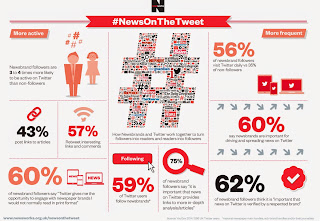
  • Why are respected news brands good news for Twitter?
"59% of users follow newspaper brands". Google Glass was controversial as it impending arrival of the new gadget as sparked some outrage and debate. There is a sense of alienation flowing from the arrival of the product that it might just dehumanise us. i.e desensitise us and also make us less social in terms of connecting with people in real life for instance. Its is also very pricey within its thousand pound ranges and it is rumoured that more competition is on its way from Microsoft and apple, which will bring the price down.
  • Why in turn is Twitter good for respected news brands?
This is because trust is created from the consumers and well known brands being on social media means they have instant access. Therefore in order for consumers to get this immediacy they would need to have a social media site to meet the needs f the consumers quicker making them more convenient. Therefore it allows newspapers as a result the audiences have a wider variety of analysis and opinion, giving a balanced and diverse view on a issue, allowing the community to be connected. Twitter, meanwhile, offers instant access to the ever-changing news landscape, the diversity and balance to open up their users to a variety of newsbrands and journalists, and a means of connecting with the newsbrands and their content that could never have happened in the pre-Twitter landscape.
  • The report suggests that old and new media “are not, in fact, in direct competition, but often work extremely well together to enhance both the media eco-system and the consumer experience”. What evidence do they provide to support this idea? Do you agree with it?
Together, Twitter and newsbrands can address the needs states and expectations of the demanding news audience far better than individually. When the three connected elements of the newsbrand eco system work to get the best out of the unique platform that Twitter provides, there is a synergy that really does create a whole that is stronger than the sum of its parts. Newsbrands bring trust, access to deeper analysis and expert opinion, as well as content and brand markers that can identify communities of like-minded people.
  • On page 24/25 of the report, the focus turns to 'gossip' or 'banter'. What example tweets from journalists are used to illustrate this? 
                      - Dan Wootton @danwootton • Feb 20 Red carpet awks moment from last night as my                               microphone chord gets stuck to @KlassMyleene’s dress!
                       -I reveal the shocking truth behind Jennifer Aniston’s new hair
  • Do you think the increasing amount of 'gossip' or 'banter' is harming the reputation of news and journalists?
Gossip and banter about celebrities, sports or political scandals are all part of the entertainment and are often turned to when news brand followers want to relax.this may frustrate the reader rather than humour them as these are 'click baits' rather then truthful stories, so this is a way of newspapers being greedy and looking for  ways to make money.some examples of 'click bait' (examples above).  
  • What does the report say about trust in Twitter and journalists (look at pages 34-39)?
techno-panic is a moral panic that centres on fears regarding specific contemporary technology or technological activity.
  • Finally, do you think new and digital media developments such as Twitter have had a positive or negative impact on traditional newspapers?
I don't agree with this as I think that MNC's already have so much media power and control over us that for us as consumers to be giving into the temptation of such a new gadget would just be wrong. Its a violation of our privacy and its a way of slyly finding out information that we all would rather chose to keep quite private.